




Listen to this article
AI is quickly moving from experimentation into enterprise execution. For many organizations, the question is no longer whether AI can create value. The harder question is how to make AI work inside the systems, workflows, governance models, and operating structures that run the business every day.
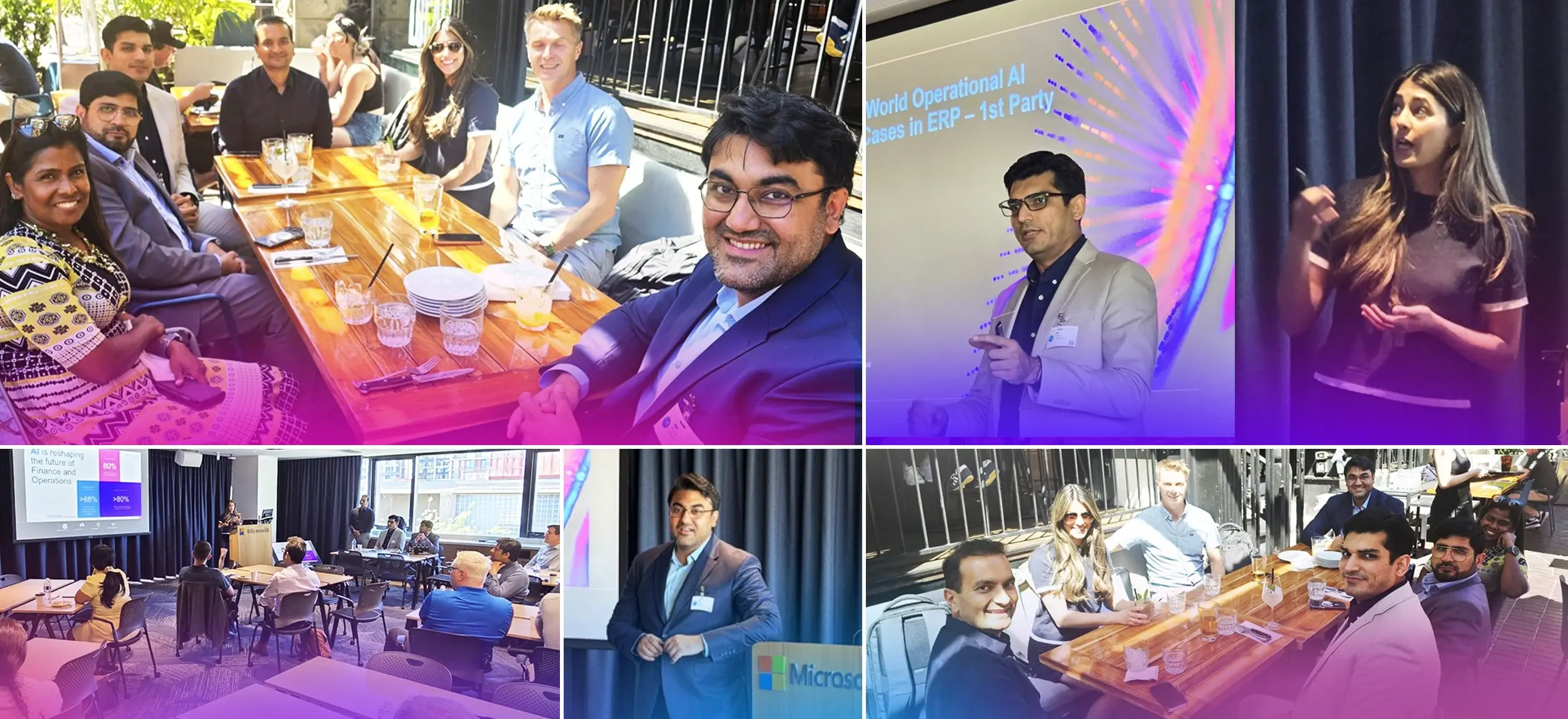
That was the focus of Visionet-Microsoft executive workshop in Vancouver, From insight to action: AI, agents, and the future of ERP. The session brought together enterprise, finance, operations, and technology leaders to discuss how AI, agents, Copilot, Copilot Studio, and Model Context Protocol are reshaping ERP systems and enterprise operations.
The central theme was clear: ERP is no longer just a system of record. It is becoming an intelligent operational platform that can understand context, generate insights, orchestrate workflows, and help teams take action faster.
From AI experimentation to enterprise execution
Many organizations have already tested AI through pilots, proofs of concept, and limited use cases. These experiments have helped teams understand what AI can do, but they have also exposed a common challenge: AI does not scale well when it is disconnected from business processes, enterprise data, and operating governance.
This is where the conversation is shifting. Enterprise AI is becoming less about isolated tools and more about connected execution. Leaders are asking how AI can support real workflows across finance, supply chain, customer operations, commerce, and enterprise applications.
That shift aligns closely with the broader enterprise AI adoption conversation in Canada. As Visionet explored in its article on enterprise AI adoption in Canada, organizations need more than enthusiasm for AI. They need readiness across strategy, data, governance, adoption, and business process design.
The workshop reinforced the same point: AI value depends on how well organizations connect intelligence to execution.
Why ERP is central to the next phase of AI
ERP systems sit at the center of how organizations manage finance, operations, supply chain, procurement, commerce, and customer-facing workflows. That makes ERP one of the most important environments for enterprise AI.
AI can support better decisions, but those decisions only become valuable when they connect to the systems where work actually happens. In practical terms, that means AI must sit close to order management, financial reconciliation, procurement coordination, inventory visibility, customer service, planning, and operational workflows.
This is why modern ERP strategy matters. Microsoft Dynamics 365 ERP services in Canada focus on helping organizations modernize core operations with AI-enhanced business applications, unified processes, real-time visibility, and stronger decision-making foundations.
The workshop highlighted that AI-enabled ERP is not simply about adding intelligence on top of existing systems. It is about rethinking ERP as an operational layer where data, decisions, workflows, and automation come together.
From copilots to agents: what changes for enterprise workflows
A major part of the discussion centered on the movement from copilots to agents. Copilots help users work faster by assisting with tasks, surfacing information, generating content, and improving productivity. Agents go further by helping coordinate workflows, take context-aware actions, and support more autonomous execution across processes.
For enterprise leaders, this raises important questions:
Which workflows are ready for agentic execution?
Where should human oversight remain in the loop?
How should governance, security, and compliance be designed?
How can organizations avoid creating disconnected AI tools that do not scale?
What data foundations are needed before agents can work reliably?
This is where business and technology strategy must come together. AI agents need access to trusted data, clear process logic, secure integrations, and well-defined boundaries. Without those foundations, organizations may create impressive pilots that fail to deliver sustained operational value.
Practical AI use cases are moving into operations
The workshop focused on practical AI use cases rather than abstract AI possibilities. Discussions covered how organizations are applying AI across areas such as financial reconciliation, accelerated close, supplier communication, procurement coordination, sales order automation, exception management, customer service, voice-order experiences, store operations, workforce productivity, commerce personalization, and operational risk reduction.
These use cases matter because they are directly connected to business performance. They reduce manual effort, improve response times, support better decisions, and create more consistent execution across the enterprise.
Generative AI services in Canada are built around this same outcome-led approach: identifying high-value business processes, improving productivity, supporting secure adoption, and connecting GenAI initiatives to measurable ROI.
The real opportunity is not just to deploy AI. It is to identify the workflows where AI can remove friction, improve visibility, and help teams act with more speed and confidence.
Governance and readiness determine whether AI scales
One of the most important themes from the workshop was that AI transformation is not only a technology discussion. It is also a governance, data, security, and operating model discussion.
To move from pilots to production, organizations need clarity on:
Data readiness and quality
Role-based access and security
Governance and responsible AI controls
Change management and adoption
Workflow redesign
Measurement and ROI
Integration with enterprise systems
This is where many AI initiatives stall. The technology may be promising, but the organization is not always ready to operationalize it. Leaders need to think about how AI fits into enterprise architecture, how employees will use it, how risks will be managed, and how value will be measured.
For organizations evaluating AI platforms and accelerators, GenAI Studio provides a way to fast-track GenAI adoption with pre-built solutions, connectors, multi-cloud architecture, security guardrails, and a structured path from proof of concept to production.
That kind of approach is increasingly important because enterprise AI success depends on moving quickly without losing control.
The Microsoft ecosystem is becoming a key execution layer
The workshop also explored how Microsoft technologies such as Copilot, AI Agents, Copilot Studio, Model Context Protocol, and Dynamics 365 are shaping the next generation of enterprise execution.
For many Canadian organizations, Microsoft is already deeply embedded across productivity, collaboration, ERP, CRM, data, and cloud environments. That creates a practical opportunity: AI can become more valuable when it is integrated into platforms people already use and workflows organizations already depend on.
However, implementation still matters. Selecting the right platform is only one part of the journey. Organizations also need the right partner to align technology decisions with business goals, process realities, governance needs, and long-term scalability.
This guide on choosing the right Microsoft Dynamics 365 partner explains why partner selection is critical for organizations looking to modernize business applications and build a future-ready operating model. The workshop reinforced this point: the future of ERP will not be shaped by technology alone. It will be shaped by how well organizations design, implement, govern, and adopt that technology.
What this means for Canadian enterprises
For Canadian organizations, the next phase of AI adoption will require a practical balance between ambition and readiness. The market is moving quickly, but enterprise leaders need to avoid treating AI as a disconnected innovation layer. AI must be tied to business processes, ERP systems, data foundations, security models, and measurable outcomes.
The organizations that move ahead will likely be the ones that can answer a few critical questions:
Which business workflows are ready for AI-enabled execution?
Where can agents improve decision-making or reduce manual work?
Is the ERP environment ready to support intelligent operations?
Is enterprise data trusted, governed, and usable?
Are security and compliance controls in place?
How will value be measured beyond pilot success?
These questions are now central to enterprise transformation. They are also central to how Visionet Canada helps organizations modernize technology environments, scale AI responsibly, and connect innovation to business execution.
The conversation has moved beyond pilots
The biggest takeaway from the workshop was simple: enterprise AI is entering a more practical phase.
Organizations are no longer only asking what AI can do. They are asking how AI can operate securely, responsibly, and profitably inside the business. That means ERP, data, governance, workflows, and adoption are now part of the AI conversation.
The future of ERP is not just more automation. It is a more intelligent operating model where systems understand context, surface insight, coordinate work, and help teams act faster.
For enterprises ready to move from insight to action, the priority is clear: build the foundation that allows AI, agents, and ERP to work together as part of real business execution.
Enterprise AI adoption: What leaders need to know (FAQs)
What is AI-enabled ERP?
AI-enabled ERP uses AI, copilots, and agents to help teams move from data entry and reporting to faster insights, workflow automation, and smarter decision-making.
How are AI agents changing ERP?
AI agents can help coordinate tasks, trigger actions, and support business workflows across finance, operations, supply chain, and customer service.
Why do AI pilots fail to scale?
AI pilots often fail when they are not connected to clean data, core systems, governance, security, and real business workflows.
Why is ERP important for enterprise AI?
ERP connects the processes that run the business. When AI is embedded into ERP, insights can turn into action across real operational workflows.
How can organizations prepare for AI-enabled ERP?
Organizations should focus on data readiness, governance, secure integrations, clear use cases, user adoption, and measurable business outcomes.
Ready to explore what AI-enabled ERP could look like for your organization?
Visionet Canada helps enterprises modernize ERP, build AI-ready data foundations, operationalize GenAI, and design secure, scalable pathways from pilot to production.
To discuss your AI, ERP, or enterprise modernization roadmap, get in touch with the experts.
Need guidance on this topic?
Our Canada leadership team can help you explore solutions tailored to your business.

Shariq Rehman
Head of Strategic Business,
Global Alliances & Canada Market