




Listen to this article
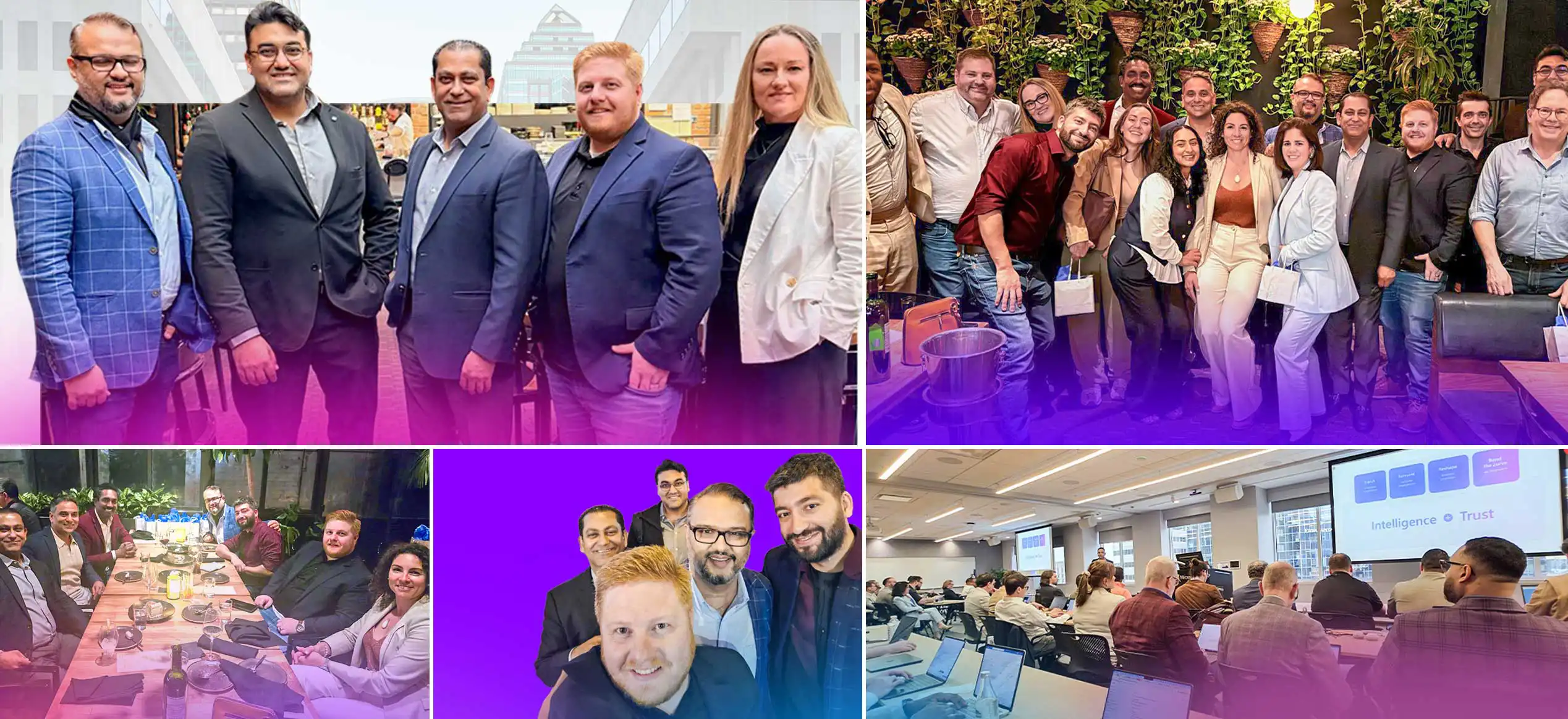
Insights shared during a recent Visionet and Microsoft Canada discussion reinforced a growing reality for business leaders: AI adoption is no longer the differentiator. The organizations pulling ahead are those that can operationalize AI across people, processes, and systems.
For the past few years, enterprise AI conversation has been dominated by AI adoption at scale. Organizations in Canada have invested heavily in new technologies, launched pilot programs, and explored countless use cases to unlock value from AI.
Today, the conversation is changing.
As AI moves from experimentation to execution, business leaders are realizing that adoption alone is no longer enough. The real challenge lies in operationalization. This includes embedding AI into core business processes, scaling it responsibly, and driving measurable outcomes across the enterprise.
This shift is shaping the future of AI in Canada. Powered by innovations such as Microsoft Copilot and the rise of agentic AI, organizations are beginning to rethink how work gets done. Yet technology is only part of the equation. Success will depend on an organization's ability to combine AI agents, governance, and connected business systems into a scalable AI strategy.
The enterprises that gain a competitive edge will be those that transform AI from experimentation into operational impact.
Why AI Adoption at Scale Remains a Leadership Challenge
The Challenge
Many organizations have successfully launched AI pilots, but few have scaled them across the enterprise. AI initiatives often emerge within individual business functions, creating isolated pockets of innovation rather than a unified transformation strategy.
Without a coordinated approach, organizations struggle to connect AI investments to broader business objectives.
The Impact
The result is fragmented adoption, inconsistent governance, and limited business value. While individual teams may realize productivity gains, enterprises often fail to achieve the operational efficiencies and strategic outcomes that justify large-scale AI investments.
As AI initiatives multiply, these gaps become more pronounced, making it harder to scale innovation and maintain alignment across the organization.
The Solution
Scaling AI adoption at scale requires more than introducing new technologies. It demands a clear AI strategy, strong governance, and integration with core business processes.
Leading organizations are moving beyond isolated use cases and building an AI-driven enterprise, one in which AI is embedded across workflows, decision-making, and operational systems to deliver measurable business impact.
The Rise of Agentic AI and the AI-Driven Enterprise
The next phase of enterprise AI isn't about deploying more tools, but reimagining how work gets done. This shift is being driven by agentic AI, which moves beyond assistance to action.
Then: AI-Assisted Work
The first wave of AI focused on productivity. It helped employees generate content, summarize information, and support decision-making. While valuable, these capabilities remained largely task-specific and dependent on human input.
Now: AI Agents Drive Action
Today's AI agents can understand context, execute multi-step tasks, interact with business systems, and coordinate workflows. Instead of simply responding to requests, they help orchestrate work across the enterprise.
What This Means for Enterprises
As organizations embed agentic AI into their business processes, they move closer to becoming AI-driven enterprises. Here, intelligence is integrated into everyday operations, enabling more scalable and AI-powered operations.
The opportunity is no longer just to use AI, but to redesign work around it.
Microsoft Copilot and the Evolution of Work
Observation
Organizations are increasingly adopting Microsoft Copilot to improve productivity, streamline workflows, and reduce the burden of repetitive tasks. From content creation and data analysis to meeting summaries and knowledge retrieval, AI is becoming a part of the modern workplace.
Insight
The real transformation, however, isn't about doing the same work faster—it's about changing how work is executed. As AI agents become more capable, they can move beyond assistance to support decision-making, coordinate tasks, and orchestrate workflows across functions.
This evolution is accelerating the shift toward a more AI-driven enterprise, where humans and intelligent systems work together to improve efficiency, responsiveness, and business outcomes.
To learn more about how organizations are preparing for this shift, explore Visionet's podcast on the Future of Work with Microsoft Copilot Agents.
Why Governance Is the Foundation of AI Adoption at Scale
The Wrong Question
Many organizations are focused on one question: How quickly can we deploy AI?
While speed matters, an aggressive rollout without clear guardrails can create challenges around security, compliance, accountability, and data integrity, especially as AI agents become more deeply embedded in business processes.
The Better Approach
A more important question is: How do we scale AI responsibly?
Successful AI adoption at scale requires more than technology. It requires a well-defined AI strategy, clear governance frameworks, and operating models that ensure AI systems are secure, transparent, and aligned with business objectives.
This becomes even more critical in the era of agentic AI, where intelligent systems are increasingly capable of acting on information and influencing outcomes.
The organizations realizing the greatest value from AI are not necessarily deploying it the fastest. They are scaling it with purpose.
By embedding governance into their AI initiatives from the outset, they are building trust, reducing risk, and creating a foundation for sustainable growth. In doing so, they are positioning themselves to become truly AI-driven enterprises, capable of turning innovation into long-term operational impact.
For a deeper look at scaling AI responsibly, explore Visionet's whitepaper on Scaling Governed AI Agents from Pilots to Frontier Firms.
AI Is Only as Smart as the Business Context Behind It
As organizations scale AI, one reality becomes increasingly clear: AI is only as effective as the business context it can access.
AI Needs More Than Data
AI models can process vast amounts of information, but without access to operational context, their outputs remain limited. Understanding customers, financial performance, inventory levels, or supply chain dynamics requires connected business intelligence.
Context Drives Better Decisions
The most effective AI-powered operations are built on a foundation of integrated systems and trusted data. When AI can access information across functions, it can generate insights that are more relevant, actionable, and aligned with business goals.
Enterprise Systems Create Enterprise Intelligence
The future of AI will be shaped by smarter models and smarter connections between people, processes, and systems. Organizations that unify their operational data are better positioned to become an AI-driven enterprise, where intelligence flows smoothly across the business.
This is where enterprise platforms become critical, not just as systems of record, but as systems of intelligence.
ERP Transformation: From Systems of Record to Systems of Intelligence
Then: Capturing Business Data
Traditionally, ERP systems were designed to standardize and manage core business processes. They served as systems of record, providing a single source of truth for finance, supply chain, inventory, and operations.
While this foundation remains critical, today's enterprises require more than visibility into historical data.
Now: Enabling Intelligent Decisions
As organizations pursue ERP transformation, ERP platforms are evolving into systems of intelligence. By connecting operational, financial, and customer data, they provide the context needed to power AI-powered operations and support enterprise-wide decision-making.
Modern platforms such as Dynamics 365 enable organizations to move beyond data management and unlock real-time insights, helping teams respond faster, plan better, and operate more efficiently.
To learn more about how organizations are modernizing business operations, explore Visionet's Dynamics 365 ERP solutions.
Next: Powering the AI-Driven Enterprise
As AI agents become more deeply integrated into business processes, enterprise systems will play an even greater role in orchestrating workflows, connecting data, and enabling intelligent actions across the organization.
The future of ERP transformation is not about digitizing processes. It will be about laying out the foundation for an AI-driven enterprise where intelligence is embedded in every operational decision.
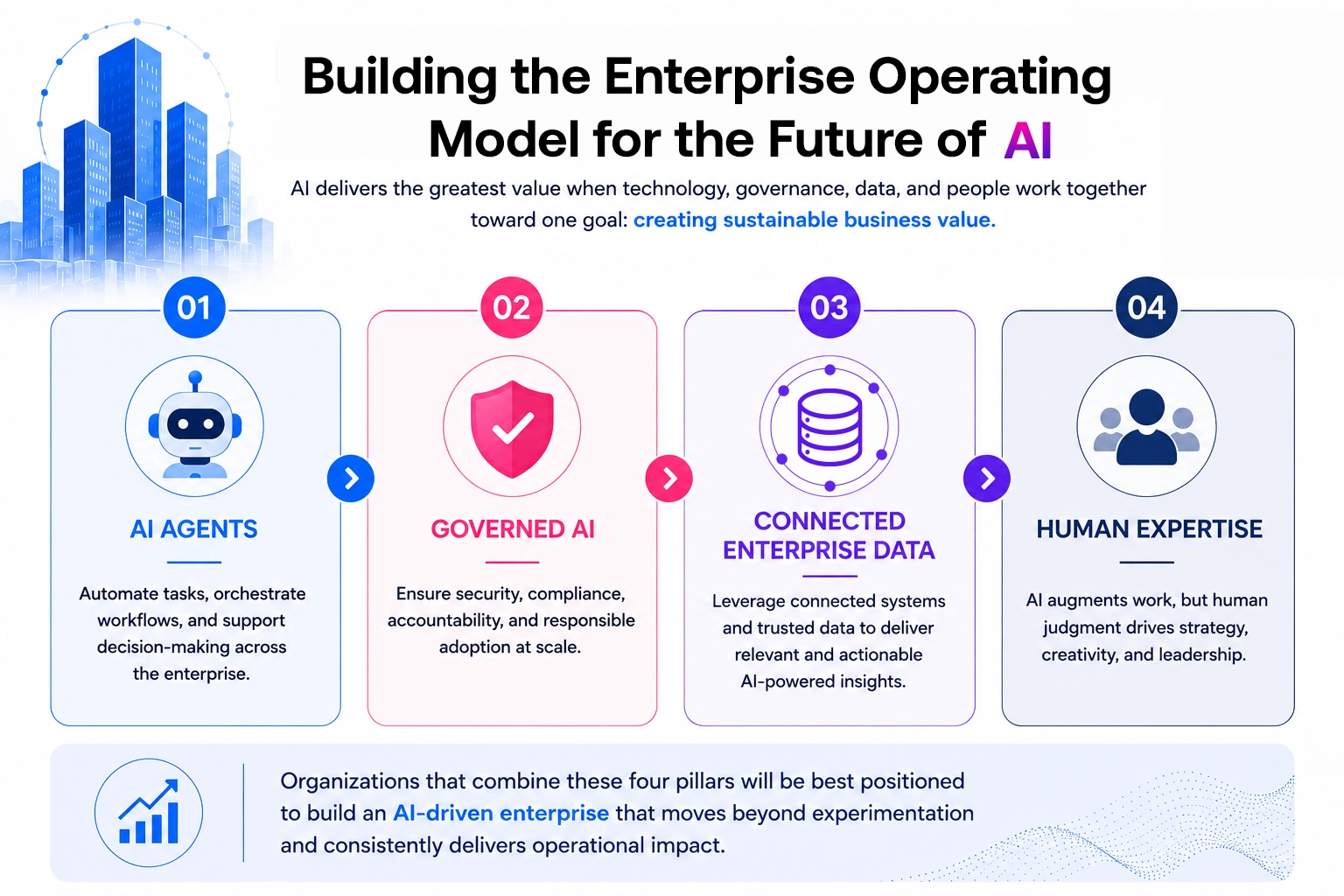
Building the Enterprise Operating Model for the Future of AI
The organizations leading the next wave of transformation share a common characteristic: they treat AI as an enterprise capability, not a standalone technology initiative.
Building for the future of AI requires more than deploying new tools. It requires an operating model that aligns technology, governance, data, and people around a common objective of creating sustainable business value.
AI Agents
The first pillar is intelligent execution. As AI agents become more capable, they can automate tasks, orchestrate workflows, and support decision-making across functions.
Governed AI
The second pillar is trust. A strong AI strategy requires governance frameworks that ensure security, compliance, accountability, and responsible adoption at scale.
Connected Enterprise Data
The third pillar is context. Effective AI-powered operations depend on connected systems and accessible business data that enable AI to generate relevant and actionable insights.
Human Expertise
The final pillar is people. While AI can augment work and accelerate decision-making, human judgment remains essential for strategy, creativity, and leadership.
Organizations that successfully combine these four pillars will be best positioned to build an AI-driven enterprise. It can move beyond experimentation and consistently translate AI investments into operational impact.
As enterprises navigate this transformation, strategic partnerships will play an increasingly important role. Through its collaboration with Microsoft, Visionet is helping organizations accelerate AI adoption, modernize operations, and build the foundations required for long-term success. Learn more about the Visionet-Microsoft Alliance and how organizations are preparing for the next era of enterprise innovation.
The themes explored during Visionet's recent discussion with Microsoft are already reshaping enterprise priorities, from AI adoption and governance to operationalization at scale, and will continue to influence how organizations build for the future of AI.
Frequently Asked Questions (FAQs)
1. What does it mean to operationalize AI?
Operationalizing AI means embedding AI into business processes, workflows, and decision-making to deliver measurable and scalable business outcomes.
2. What is agentic AI?
Agentic AI refers to intelligent systems that can reason, act, and coordinate tasks across workflows with minimal human intervention.
3. How are AI agents different from traditional AI tools?
Traditional AI tools assist with individual tasks, while AI agents can execute multi-step actions, interact with business systems, and help orchestrate workflows.
4. Why is governance important for AI adoption on scale?
Governance ensures AI systems are secure, compliant, accountable, and aligned with business objectives, enabling organizations to scale AI responsibly.
5. How does Microsoft Copilot support enterprise transformation?
Microsoft Copilot enhances productivity by helping employees access information, automate routine tasks, and make faster, more informed decisions.
6. How do ERP systems support AI-powered operations?
Modern ERP platforms provide the connected data and business context that AI needs to generate relevant insights and support intelligent decision-making.
7. What are the key building blocks of an AI-driven enterprise?
An AI-driven enterprise is built on four core pillars: AI Agents, Governed AI, Connected Enterprise Data, and Human Expertise.
Need guidance on this topic?
Our Canada leadership team can help you explore solutions tailored to your business.

Shariq Rehman
Head of Strategic Business,
Global Alliances & Canada Market