





Listen to this article
How AI for Integrated Evidence Planning enables evidence gap prediction, synthesis, and IEP drafting give Medical Affairs and Market Access teams the infrastructure to move from coordination to impact
The gap between IEP strategy and IEP execution
Most pharmaceutical organizations understand what a strong integrated evidence plan should accomplish. It should connect every evidence-generating activity to a specific stakeholder decision. It should surface gaps before they become expensive. It should stay current as the competitive and regulatory environment shifts. It should give Clinical Development, Medical Affairs, HEOR, and Market Access a shared operational baseline rather than a set of parallel plans.
What most organizations also understand is that their current IEP process does not actually do this. The strategy is clear. The execution is where it frays.
The execution gap has a structural cause. Integrated evidence planning requires processing a volume and variety of information: published literature, competitor clinical programs, HTA precedents, payer coverage signals, real-world evidence from post-approval studies, regulatory guidance updates, that exceeds what cross-functional teams can synthesize manually at the pace the market demands. The result is evidence programs that are reactive rather than anticipatory, and evidence plans that describe what studies will be run rather than what decisions they are designed to move.
The challenge isn't creating a plan. It's keeping everyone aligned to it—and keeping the plan aligned to a market that keeps moving.
AI for Integrated Evidence Planning changes this constraint. For teams evaluating AI in Medical Affairs and Market Access, the value is not in replacing evidence strategy judgment, but in giving those professionals the continuous synthesis and gap intelligence that makes proactive, connected evidence planning operationally feasible for the first time.
What AI-native evidence intelligence actually means
There is a meaningful difference between using AI tools for individual evidence tasks, summarizing a paper, answering a question from a clinical database, and deploying an AI-native evidence intelligence platform architected around the full IEP planning cycle.
AI tools make individual analysts faster. An AI-native evidence intelligence platform restructures what the team can attempt. It changes the operational ceiling on what evidence planning can look like in practice: from periodic gap review to continuous gap monitoring, from manual competitive tracking to automated signal detection, from a static evidence matrix to a living stakeholder evidence map that updates as new information arrives.
The distinction matters when evaluating capability investments. The question is not whether AI can help with literature review in isolation. It is whether the AI architecture supports the complete IEP workflow, from identifying what evidence is needed, to understanding what exists, to surfacing what is missing, to producing a structured evidence plan that teams can immediately build on.
Visionet Evidence AI Analyst: three capabilities that close the execution gap
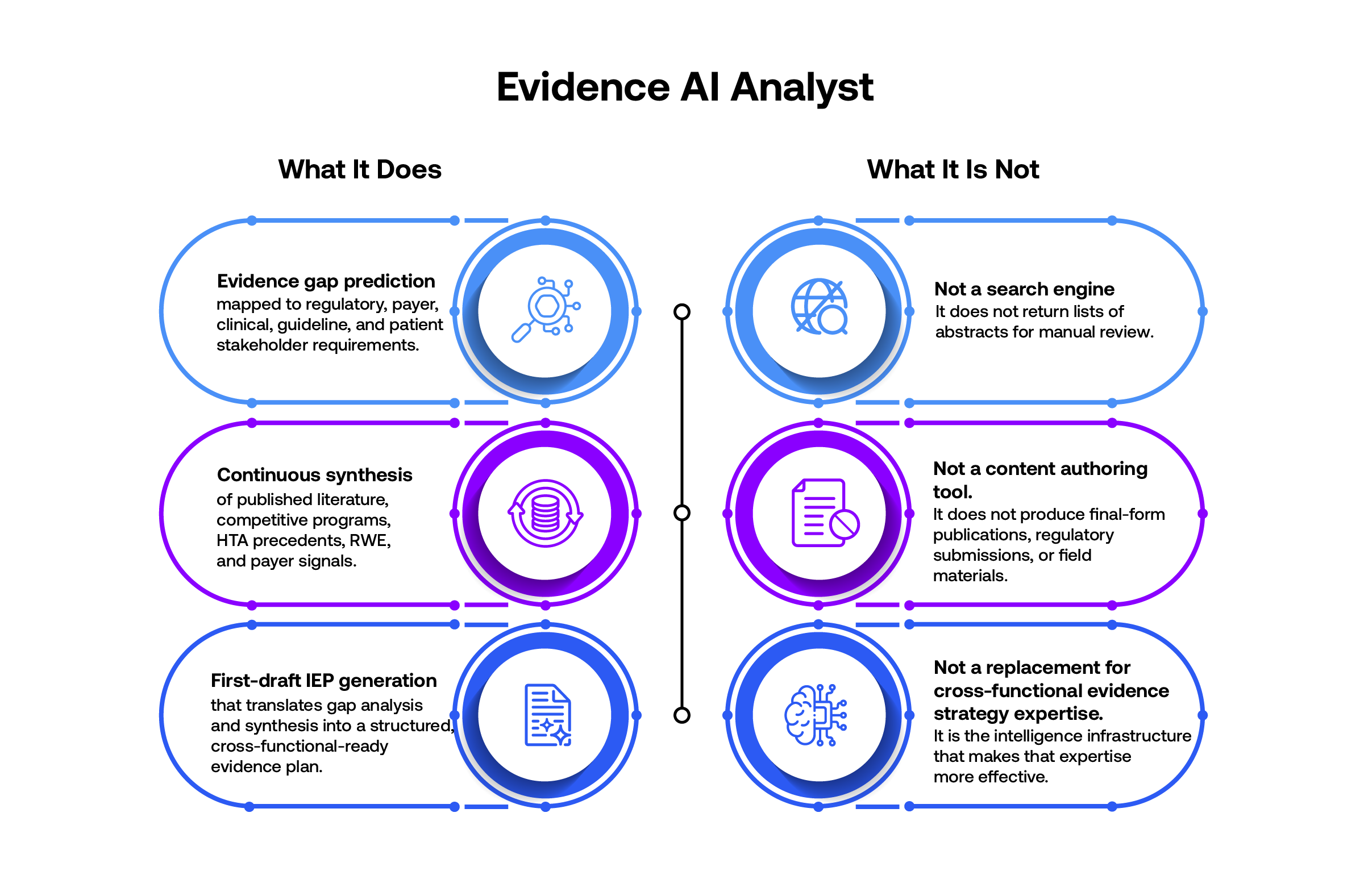
Visionet's Evidence AI Analyst is built around three core capabilities, each addressing a distinct point in the IEP execution cycle where traditional processes break down.
1. Evidence gap prediction
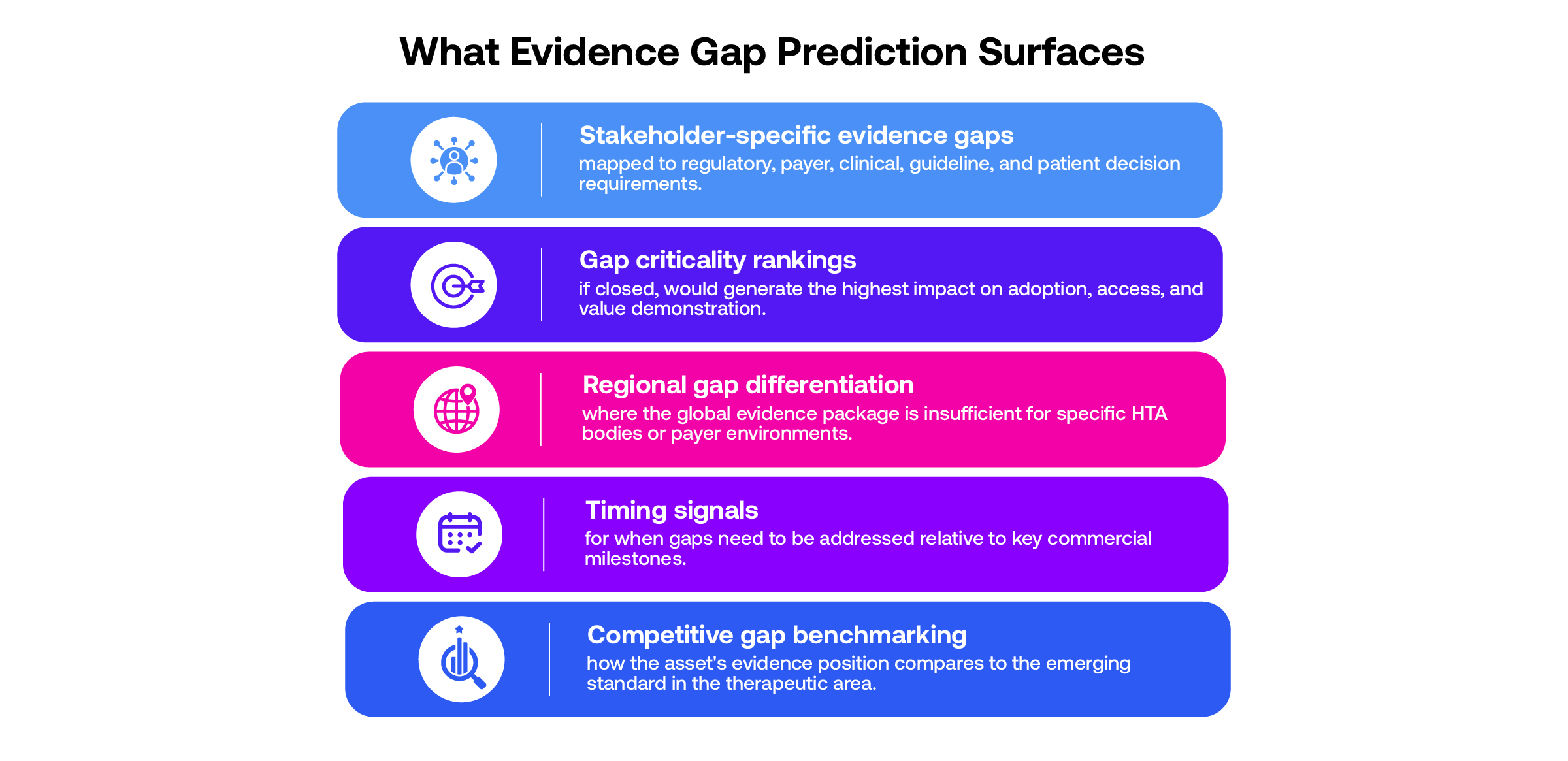
The first and most foundational capability is predictive evidence gap analysis. The platform maps an asset's current evidence base against the decision requirements of each relevant stakeholder group, regulatory bodies, payers and HTA bodies, clinical prescribers, guideline committees, and patient advocacy, and identifies where the gaps are, how critical they are, and at what point in the development or commercial lifecycle they need to be closed.
This is not a static gap matrix populated at a planning cycle and reviewed quarterly. It is a continuously updated analysis that reflects new published data, evolving payer coverage criteria, shifting HTA precedents, and competitor evidence developments as they occur. When a competitor's Phase III readout changes the comparative effectiveness landscape, the gap analysis updates. When a major payer revises its coverage criteria for a therapeutic class, the evidence requirement mapping reflects that change.
2. Evidence synthesis
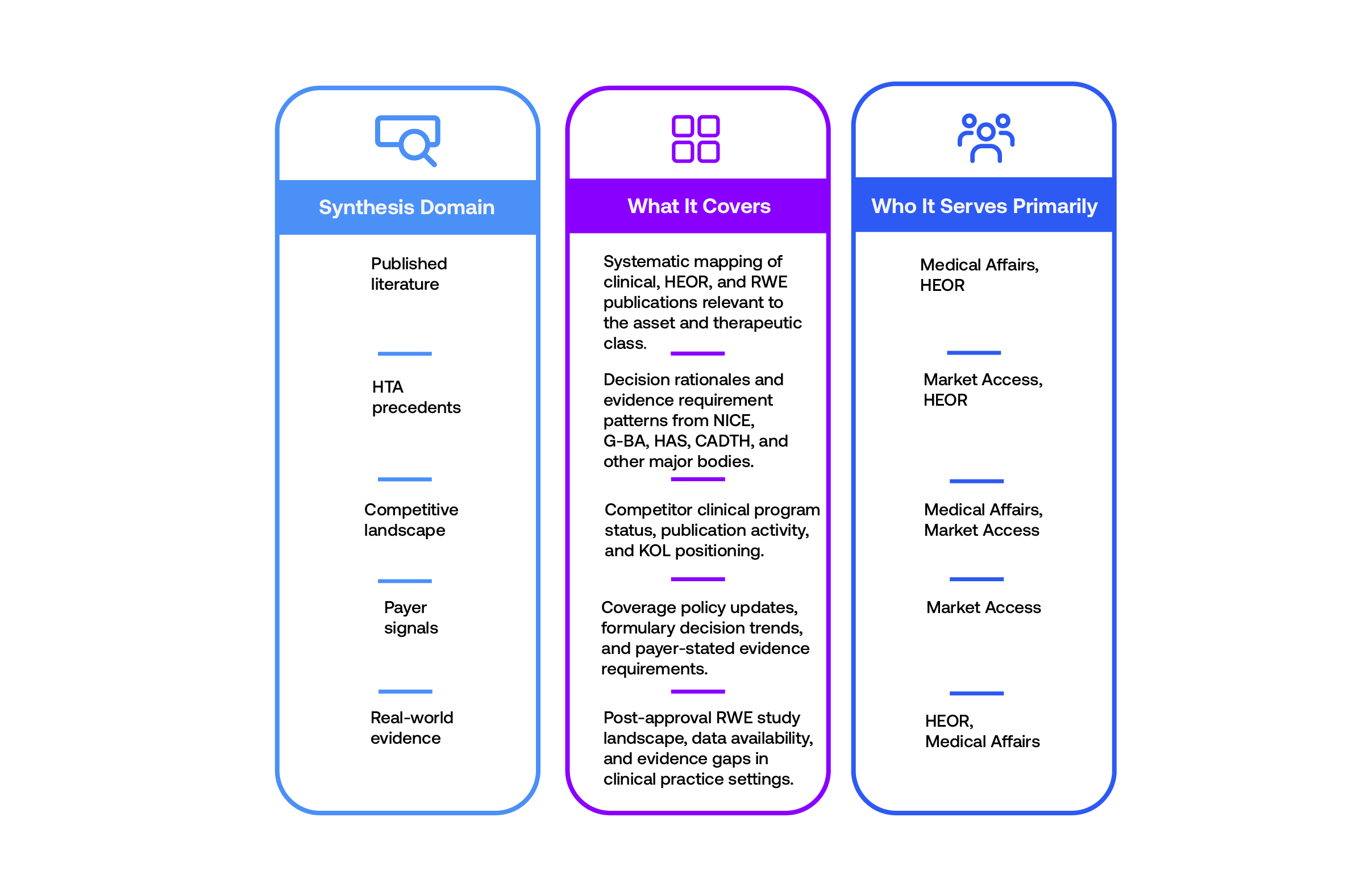
The second capability is evidence synthesis at a scale and speed that is not achievable through manual review. The platform aggregates published literature, competitor clinical programs, real-world evidence, HTA decision rationales, and payer policy documentation and synthesizes the implications for the asset's evidence position continuously.
The synthesis layer serves multiple use cases across functions. For Medical Affairs, it provides a current, structured view of the evidence landscape in a therapeutic area, what has been published, what the emerging scientific narrative looks like, where KOL positions are forming, and what publication gaps exist relative to the competitive set. For Market Access, it surfaces how comparable assets have been evaluated by HTA bodies and what evidence packages have succeeded or failed in payer negotiations. For HEOR, it aggregates real-world evidence and health economic data relevant to the asset's value story.
Critically, all synthesis outputs are traceable to their source documents. Every claim, every synthesis conclusion, every identified gap maps back to the underlying evidence base. This is not a black box that produces conclusions of uncertain provenance, it is an intelligence layer that surfaces structured, source-anchored insights that teams can interrogate, validate, and build on.
3. First-draft IEP generation
The third capability is what connects gap prediction and evidence synthesis to tangible output that teams can act on immediately: a structured first draft of the integrated evidence plan itself.
This is a meaningful operational shift. In the traditional IEP process, assembling a plan requires weeks of cross-functional workshops, manual evidence reviews, gap analysis sessions, and drafting cycles. The output is typically a document that is already partially outdated by the time it is approved. Evidence AI Analyst compresses this cycle by generating a structured first-draft IEP that incorporates the platform's gap analysis and synthesis findings into a plan framework that the cross-functional team can refine, validate, and build on.
The first-draft IEP is organized around the stakeholder decision framework—regulatory, payer, clinical, guideline, patient, and maps proposed evidence activities to the specific decisions they are designed to support, the gaps they are intended to close, and the timeline considerations that govern sequencing. It is not a finished deliverable. It is a high-quality starting point that gives cross-functional teams something concrete to react to rather than a blank page to fill.
A first-draft IEP generated from a continuously updated evidence base gives teams weeks back in the planning cycle, and a baseline that reflects the current market, not the market as it was six months ago.
The practical effect is that evidence teams can spend their cross-functional planning time on strategy and judgment, validating the draft, stress-testing the gap prioritization, aligning on resource allocation, debating the sequencing of evidence activities, rather than on assembling the baseline that makes those conversations possible. The plan becomes the starting point for strategic dialogue rather than the output of it.
How the three capabilities work together
Individually, each of these capabilities addresses a real operational bottleneck in the IEP execution cycle. Together, they create something more valuable: an evidence intelligence loop that keeps the plan connected to the market as it evolves.
Gap prediction surfaces what evidence is missing and why it matters. Synthesis tells teams what the landscape looks like and what the competitive and regulatory environment requires. First-draft IEP generation translates both into a structured plan that the cross-functional team can act on immediately. As new information arrives, a competitor publication, a payer policy update, a new HTA guidance, the cycle refreshes. The plan stays current. The gaps stay visible. The team stays ahead.
This is what BCG means when it describes connected evidence planning as a structural shift rather than an incremental improvement. It is not about doing the same process more efficiently. It is about having an evidence planning capability that responds to a dynamic environment in real time, rather than one that catches up to it quarterly.
Who this is built for
Evidence AI Analyst is designed for the cross-functional evidence planning teams who carry operational responsibility for IEP execution in pharmaceutical organizations. In practice, the primary users span three functions:
- Medical Affairs leaders who are responsible for evidence-based scientific narrative, publication strategy, KOL engagement, and ensuring that the organization's evidence activities support the clinical and scientific claims the product makes. For these teams, the synthesis and gap prediction capabilities provide continuous landscape intelligence that was previously available only through periodic, labor-intensive review.
- Market Access and HEOR teams who are building the value evidence package for payer negotiations, HTA submissions, and formulary positioning. For these teams, the HTA precedent synthesis and stakeholder-mapped gap analysis give them a current, structured view of what evidence will be required and what comparable assets have needed to succeed.
- Evidence strategy and IEP governance teams who are responsible for coordinating the cross-functional evidence plan and maintaining the single source of truth that operational teams work from. For these teams, the first-draft IEP capability and the continuous plan update mechanism address the coordination and version control problems that are the most persistent sources of friction in large organization evidence programs.
Where to start
The highest-return entry point for Evidence AI Analyst is early in the development cycle—before Phase III endpoint design is locked. Research published in 2025 found that integrated evidence programs initiated earlier in the development cycle generated nearly double the net present value of programs initiated later. The gap prediction and synthesis capabilities are most powerful when there is still time to act on what they surface.
For organizations with assets already in launch or post-approval lifecycle management, the competitive synthesis and payer signal capabilities offer immediate value by providing current intelligence on how the evidence landscape is shifting and where the most critical gaps in the access and adoption evidence base are.
In both cases, the practical starting point is the same: use the platform to build the current evidence baseline and run the initial gap analysis. The first-draft IEP output gives the cross-functional team a concrete artifact to align around—and a much clearer picture of where to focus evidence investment than most organizations have at the start of a planning cycle.
Ready to move from insight to action?
Whether you’re exploring new opportunities, solving operational challenges, or planning your next stage of growth, Visionet can help you move forward with clarity and confidence.
Speak with our experts to explore how we can support your business goals.