





Listen to this article
Why fragmented Integrated Evidence Plan (IEP) processes are costing pharma more than they realize, and what it takes to fix them
The coordination problem hiding in plain sight
Every pharmaceutical organization of scale has an Integrated Evidence Plan (IEP). The question is whether it is actually integrated, or whether it is a collection of function-specific documents that happen to share a name.
In most organizations, evidence planning is distributed across Clinical Development, Medical Affairs, HEOR, Market Access, RWE, and regional affiliates. Each function brings legitimate and distinct evidence priorities. Clinical Development is focused on trial endpoints and regulatory dossier requirements. HEOR is building health economic models for payer submissions. Medical Affairs is managing publication planning and KOL engagement. Market Access is tracking formulary negotiation timelines. RWE teams are scoping post-approval studies. Affiliates are translating global strategy into country-specific requirements.
None of this is wrong. The problem is what happens in the gaps between these functions. Without a unifying evidence architecture, one that connects every activity to a shared stakeholder map and a common evidence gap baseline, the plan fragments. Studies are duplicated across functions. Country-specific requirements surface too late to influence trial design. The evidence gap matrix in one team's SharePoint folder diverges from the version another team is working from. And when a competitor's data readout changes the landscape, there is no mechanism to propagate the implications across the organization at speed.
Teams spend more time coordinating evidence than generating it. That is the hidden cost of fragmented IEP.
The result, as BCG has described in its analysis of IEP maturity across biopharma, is that organizations end up with evidence programs that are disconnected, duplicated, and difficult to maintain. The plan exists. The ownership does not.
Where fragmentation happens, and why it compounds
Fragmentation in Evidence Planning in Pharma rarely starts as a strategic failure. It starts as a practical one. The organization grows, the asset portfolio expands, the number of stakeholders increases, and the informal coordination mechanisms that worked in a smaller organization stop scaling. By the time the problem is visible, it has already been compounding for months.
The patterns are consistent across organizations that have confronted this challenge:
- Multiple versions of the evidence plan circulate across functions, each reflecting the priorities and assumptions of the team that maintains it. When evidence needs to be cross-referenced, during a payer submission or a regulatory briefing, teams discover they are not working from the same baseline.
- Evidence gaps are identified reactively. A payer coverage decision is denied because the health economic evidence was not mature. A guideline submission is delayed because the publication record is thinner than the committee requires. These are not surprises, they are predictable consequences of evidence planning that does not continuously map activities to stakeholder decision requirements.
- Country-specific requirements are captured too late. Global teams build an evidence package. Regional affiliates raise country-specific payer or HTA requirements after the trial design is locked. Retrofitting evidence for regional requirements is expensive and sometimes impossible.
- Static documents become outdated. The evidence plan produced at the beginning of Phase III reflects the competitive landscape, payer environment, and regulatory guidance of that moment. Twelve months later, all three may have shifted materially. Static documents do not update themselves.
- Money is wasted on duplicate studies or redundant data acquisition. Without visibility across the full evidence program, different functions commission analyses or data purchases that overlap with work already in progress elsewhere in the organization.
The more stakeholders involved, the harder it becomes to maintain a single source of truth. And the cost of that failure accumulates quietly, study by study.
What makes fragmentation particularly damaging is that its costs are diffuse. No single decision looks catastrophic in isolation. A study that generates data the payer does not need. A publication that lands six months after the formulary window closes. A regional submission built on evidence that does not map to the local HTA framework. Each of these is a manageable setback individually. Cumulatively, they represent material lost value.
The impact when fragmentation goes uncorrected
Research published in Therapeutic Innovation & Regulatory Science in 2025 put financial modeling behind what practitioners have long understood intuitively. Using expected net present value analysis across realistic pharmaceutical lifecycle scenarios, the researchers found that well-structured integrated evidence programs generated incremental asset value of $66 million to over $127 million, with the higher figure linked to programs initiated earlier in the development cycle.
The inverse of that finding is the cost of fragmented or reactive Pharmaceutical Evidence Planning. Evidence gaps identified late cannot be closed cheaply. The evidence equivalent of a launch readiness gap—where the clinical data exists but the payer evidence does not—requires expensive post-hoc studies with compressed timelines, negotiated at exactly the wrong moment in the commercial cycle.
What Fragmented Evidence Planning Costs in Practice
- Evidence gaps are identified after the window to address them has closed.
- Decisions take longer because cross-functional alignment has to be rebuilt for each submission.
- Launch is delayed when payer or HTA evidence is not mature at the right moment.
- Teams lose visibility across the evidence lifecycle and duplicate work they cannot see.
- Money is spent on studies that generate data no stakeholder needed—because the plan was not connected to what decisions were actually being made.
The challenge, as Veranex has articulated from a commercialization strategy perspective, is that these costs only become visible after the damage is done. Companies that succeed have identified their stakeholder evidence requirements before trial design is locked, not after regulatory approval when the gaps are expensive to close and the commercial window is already counting down.
The core insight is simple but difficult to operationalize: an integrated evidence plan is not a document. It is a strategic instrument that must actively connect every evidence-generating activity to a specific stakeholder decision, at a specific point in time, in a specific geography. When it is treated as a document, it becomes a static artifact. When it is treated as a strategic instrument, it becomes a source of competitive advantage.
What connected evidence planning looks like
Leading organizations are moving beyond static evidence documents toward what BCG has called connected evidence planning, an approach that links strategy, evidence activities, and cross-functional communication in a single, continuously updated environment.
The structural shift is meaningful. Rather than each function maintaining its own evidence tracking, the organization works from a shared baseline that reflects the current state of evidence across all stakeholder types—regulatory, payer, clinical, guideline, and patient. When new data is generated, the implications flow through the plan. When a competitor publishes, the gap analysis updates. When a regional affiliate raises a country-specific requirement, it connects to the global plan rather than existing in a separate document.
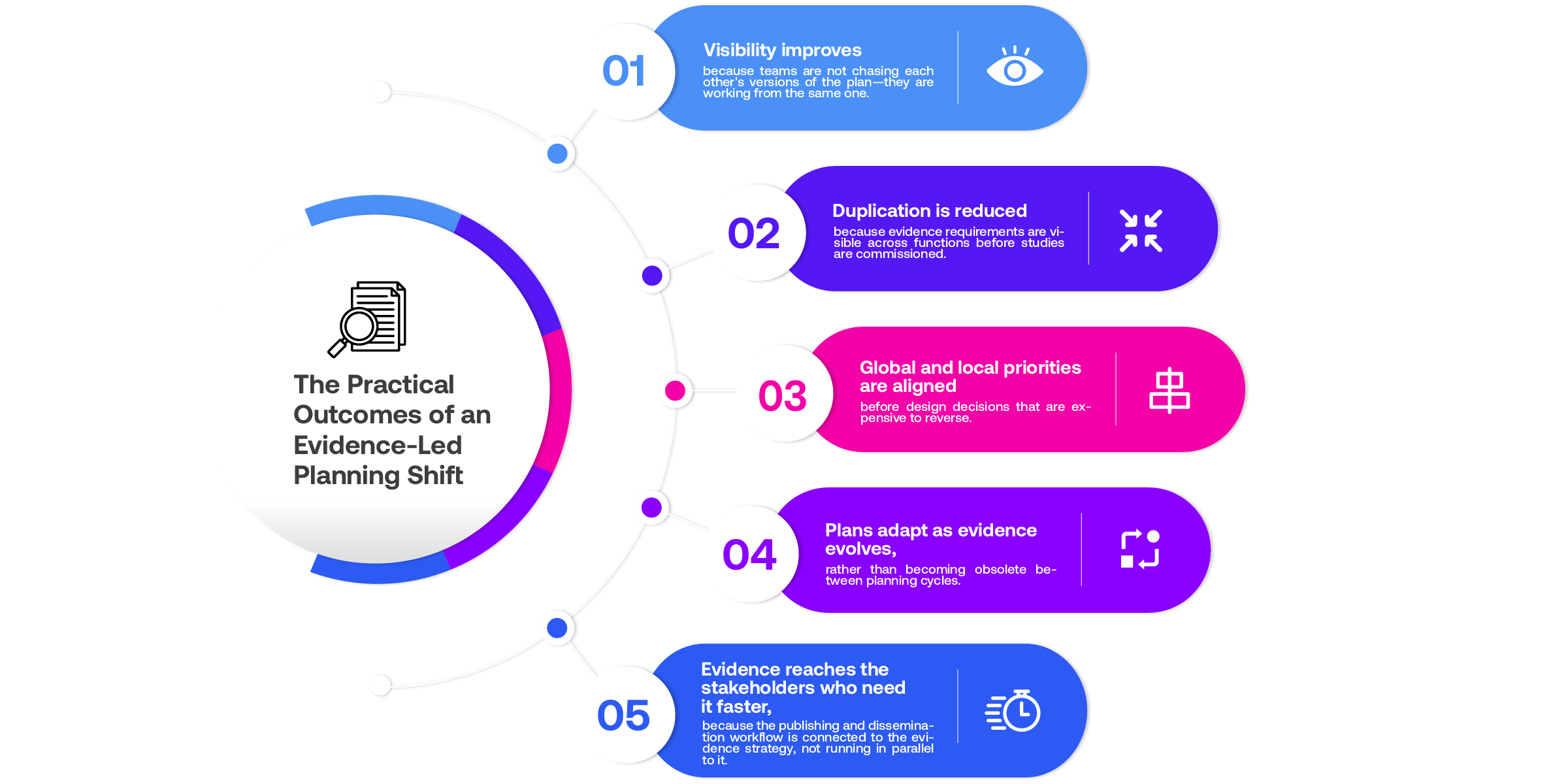
Connected evidence planning helps teams spend less time coordinating and more time creating impact. That is the shift organizations are trying to make, and the one that AI finally makes operationally realistic.
The obstacle to this vision has never been strategic clarity. Most Medical Affairs and Market Access leaders understand precisely what connected evidence planning should look like. The obstacle has been operational: the information volume is too high, the functions are too distributed, and the pace of change in the competitive and regulatory environment is too fast for manual coordination mechanisms to keep up.
That constraint is changing. Agentic AI systems built specifically for pharmaceutical evidence workflows can now maintain the continuous surveillance, gap mapping, and cross-functional synthesis that connected evidence planning requires—at a scale and speed that was not operationally achievable before. The strategic vision has not changed. The infrastructure to execute it has.
What pharma organizations need to ask themselves
The shift from fragmented to connected evidence planning does not happen through a single technology deployment. It requires honest assessment of where an organization's current process breaks down and what structural changes are needed to support a different way of working.
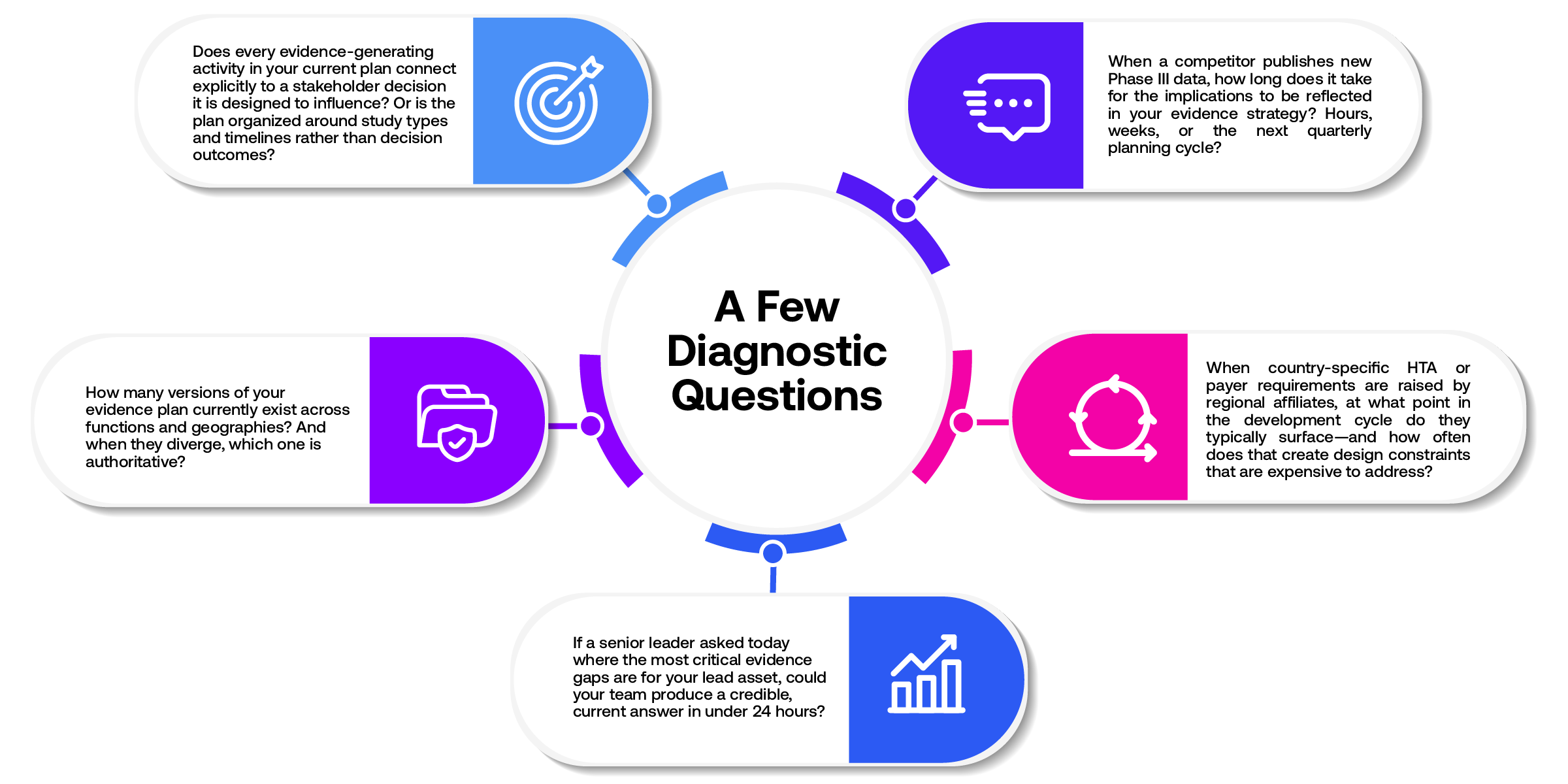
Organizations that answer these questions honestly tend to find that the gap between their evidence strategy and their evidence execution is larger than their planning documents suggest. The plan looks connected on paper. The operational reality is more fragmented.
Closing that gap is the work. And it starts with deciding to treat the integrated evidence plan as a living, cross-functional instrument rather than a document that gets produced, approved, and filed.
Ready to move from insight to action?
Whether you’re exploring new opportunities, solving operational challenges, or planning your next stage of growth, Visionet can help you move forward with clarity and confidence.
Speak with our experts to explore how we can support your business goals.