





Listen to this blog
Title search has traditionally been treated as a discrete operational step. A report is generated, reviewed, and passed forward. In practice, however, its outputs form a critical data foundation supporting underwriting clearance, closing readiness, and servicing continuity.
When title search functions independently from the broader mortgage workflow, operational alignment gaps begin to emerge. These gaps are rarely visible at the point of report delivery. Instead, they appear later as friction during closing reviews, post-close audits, servicing transfers, or collateral boarding.
Title search within the broader mortgage workflow
Modern lenders are moving away from treating title as a linear checklist. Instead, they view it as a foundational data input that informs documentation integrity and lien positioning. When title search is handled in isolation, it introduces variability into what should be a structured execution process.
A connected approach recognizes that the value of title search lies not only in accuracy, but also in how well its outputs support continuity across the mortgage lifecycle. By integrating title data directly into the workflow, teams gain greater visibility into how to:
- Map title findings directly into LOS workflows
- Align title commitment preparation and Schedule B exception tracking with closing readiness
- Structure exceptions to minimize downstream reinterpretation
- Maintain standardized documentation across county and state recording environments
- Identify potential downstream interruptions earlier in the process
Operational challenges when the title search is disconnected
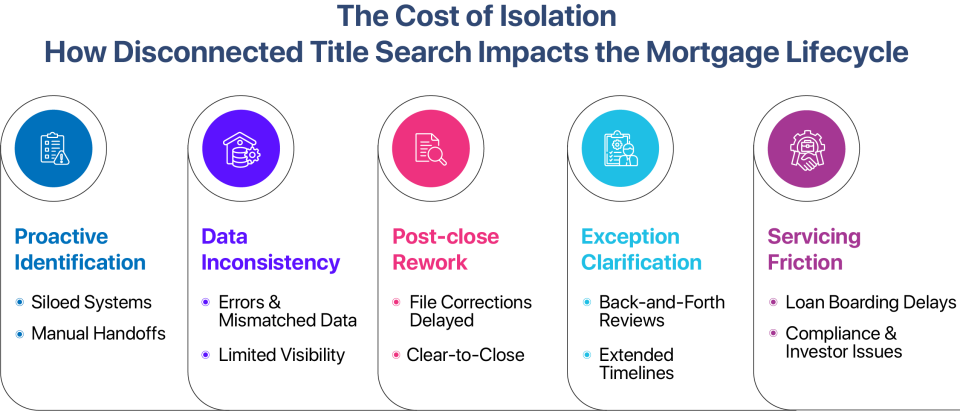
When title search operates outside of a connected framework, the result is often operational strain. This is rarely due to the quality of the search itself. More often, the challenge lies in structural misalignment.
A report may be technically accurate, but if its outputs require manual interpretation before they can be used, efficiency declines. Disconnected title processes reduce operational visibility, making it difficult to monitor exception resolution timelines or ensure lien data continuity during servicing transfers.
Files continue to move forward, but often with additional review cycles and an increased reliance on human intervention. As loan volumes fluctuate, this model becomes increasingly difficult to sustain.
Aligning title search with end-to-end execution
Visionet approaches title search as part of the broader mortgage execution framework rather than as an isolated task. The focus is on ensuring that search outputs are structured, standardized, and compatible with downstream systems from the outset.
By embedding title search within end-to-end operations, the emphasis shifts toward lifecycle continuity rather than speed alone. Key elements of this alignment include:
System-level compatibility: Standardizing title data to enable seamless LOS integration.
Structured reporting: Reducing downstream interpretation through clearer exception frameworks.
Lien continuity: Ensuring ownership data remains consistent across all lifecycle stages.
Proactive identification: Detecting potential defects earlier to reduce downstream rework.
In this model, title search becomes part of the execution architecture rather than just a standalone deliverable.
The path forward
As mortgage operations become more interconnected, title search can no longer function as a separate activity. The focus is shifting toward lifecycle continuity, structured data alignment, and earlier operational visibility.
Lenders and servicers that align title search with end-to-end execution frameworks position themselves for greater stability. In a market defined by tighter margins, consistency across workflows is no longer optional. It is a strategic requirement.
This shift supports measurable outcomes such as faster clear-to-close timelines, reduced post-close defect rates, and fewer investor exceptions during loan boarding.
Learn how Visionet helps lenders and servicers integrate title search into a connected mortgage execution framework that improves accuracy, efficiency, and lifecycle continuity.
Connect with our mortgage operations experts to explore how a connected title strategy can strengthen your mortgage workflow.
Ready to move from insight to action?
Whether you’re exploring new opportunities, solving operational challenges, or planning your next stage of growth, Visionet can help you move forward with clarity and confidence.
Speak with our experts to explore how we can support your business goals.