





Listen to this article
Imagine a global enterprise preparing for an annual compliance audit. Teams across departments scramble to gather evidence from spreadsheets, email threads, and disconnected systems. Risk assessments are stored in multiple locations, security incidents are tracked separately, and leadership lacks a clear view of the organisation's overall risk posture. What should be a structured process quickly becomes a time-consuming and error-prone exercise.
This scenario is all too common in organisations that rely on manual processes to manage governance, risk, and compliance. As regulatory requirements evolve and cyber threats become more sophisticated, businesses need a centralised approach to identify risks, maintain compliance, and respond proactively to emerging challenges.
A well-executed ServiceNow GRC implementation addresses these challenges by bringing governance, risk, and compliance activities onto a single platform. By automating workflows, standardising controls, and providing real-time visibility into risk and compliance metrics, ServiceNow enables organisations to make informed decisions while reducing operational complexity.
The result is a more resilient, audit-ready organisation that can confidently navigate today's dynamic regulatory and security landscape.
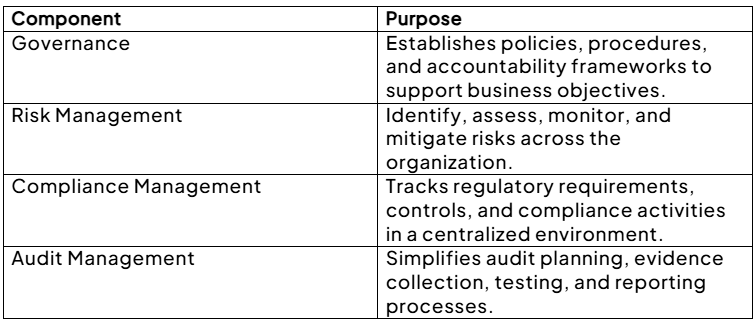
What is ServiceNow GRC, and why does it matter?
Organisations today face growing pressure to comply with regulations, manage operational risks, and maintain accountability across business functions. Managing these responsibilities through disconnected tools and manual processes often leads to inefficiencies, compliance gaps, and limited visibility into enterprise-wide risks.
ServiceNow GRC: A quick glance
Signs your organisation needs a ServiceNow GRC implementation
Not every organisation realises its risk and compliance processes have become inefficient until an audit deadline is missed, a compliance issue arises, or leadership requests visibility that existing systems cannot provide.
If any of the following challenges sound familiar, it may be time to consider a ServiceNow GRC implementation.
You may need ServiceNow GRC if:
Compliance evidence is collected manually
Teams spend hours searching through emails, spreadsheets, and shared drives to gather documentation for audits and regulatory reviews.
Risk assessments vary across departments
Different teams use different methodologies, making it difficult to measure and compare risks consistently across the organisation.
Audit preparation is resource-intensive
Auditors and compliance teams rely on repetitive manual processes to collect evidence, track findings, and generate reports.
Regulatory changes are difficult to track
New compliance requirements are managed through fragmented processes, increasing the risk of missed obligations.
Security and compliance teams work in silos
Limited collaboration between departments creates gaps in risk visibility and slows response efforts.
Leadership lacks real-time risk insights
Decision-makers struggle to obtain a consolidated view of organisational risks, controls, and compliance status.
Control testing and monitoring are largely manual
Teams spend valuable time performing repetitive tasks that could be automated through workflows and continuous monitoring.
Quick Assessment
If you checked three or more items, your organisation may be experiencing the limitations of traditional risk and compliance management approaches. A centralised GRC platform can help standardise processes, improve visibility, and create a stronger foundation for managing risk and regulatory requirements at scale.
Key steps in a successful ServiceNow GRC implementation
A successful ServiceNow GRC implementation goes beyond deploying technology. It requires a structured approach that aligns risk and compliance objectives with business goals while ensuring long-term adoption.
The following five-step framework can help organisations maximise the value of their investment.
Step 1: Assess current risk and compliance processes
Before implementation begins, organisations should evaluate their existing governance, risk, and compliance practices. This includes reviewing risk registers, compliance requirements, audit processes, control frameworks, and reporting methods.
The goal is to identify process gaps, inefficiencies, and opportunities for automation. A thorough assessment also helps establish a baseline against which future improvements can be measured.
Step 2: Define governance and compliance objectives
Once the current state is understood, stakeholders should define clear implementation goals. These objectives may include improving regulatory compliance, standardising risk assessments, automating control testing, or enhancing executive reporting.
Aligning GRC objectives with broader business priorities ensures the platform delivers measurable outcomes rather than simply replacing existing processes.
Step 3: Configure and deploy relevant GRC modules
ServiceNow offers multiple capabilities that organisations can deploy based on their specific needs. Common modules include:
- Policy and Compliance Management
- Risk Management
- Audit Management
- Vendor Risk Management
- Continuous Monitoring
Organisations should prioritise modules that address their most pressing challenges while creating a scalable foundation for future expansion.
Step 4: Integrate enterprise systems and data sources
Risk and compliance data often reside across multiple business applications. Integrating ServiceNow with systems such as ERP platforms, HR applications, security tools, and third-party solutions helps create a unified view of organisational risk.
These integrations reduce manual data entry, improve accuracy, and provide stakeholders with real-time visibility into compliance and risk metrics.
Step 5: Drive adoption and continuous improvement
Technology alone cannot transform risk management. Organisations should invest in user training, governance structures, and ongoing optimisation efforts to ensure adoption across departments.
Regular reviews of workflows, controls, and reporting capabilities help organisations adapt to evolving regulations, business requirements, and emerging risks. This continuous improvement approach ensures the ServiceNow GRC platform remains effective long after implementation is complete.
The Result
By following a structured implementation framework, organisations can move from fragmented risk and compliance management to a centralised, automated, and data-driven approach that supports better decision-making and long-term resilience.
How ServiceNow SecOps implementation strengthens GRC programs
Governance, Risk, and Compliance (GRC) helps organisations manage risks and meet regulatory requirements. However, as cyber threats become more sophisticated, organisations also need strong security operations. This is where a ServiceNow SecOps implementation complements GRC initiatives.
When combined, GRC and SecOps provide a unified approach to managing both compliance risks and security threats.
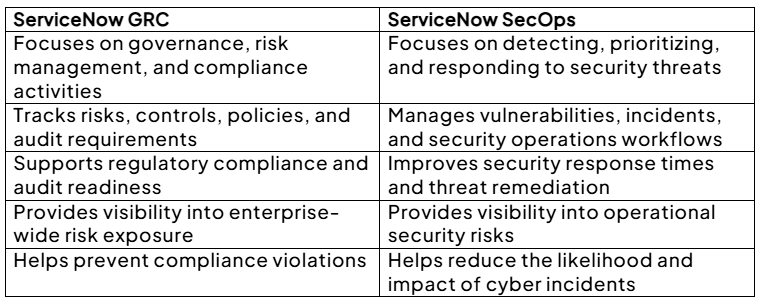
Why integrate GRC and SecOps?
A security incident affects IT, compliance, audits, and business operations. By integrating GRC and SecOps, organisations can automatically connect security events to risk assessments, controls, and remediation workflows, creating a more coordinated response.
Key benefits of combining GRC and SecOps:
- Faster risk identification and remediation
- Improved collaboration between security and compliance teams
- Better visibility into compliance impacts of security incidents
- More accurate risk reporting
- Enhanced regulatory readiness
Together, a ServiceNow GRC implementation and ServiceNow SecOps implementation help organisations build a proactive approach to risk, compliance, and cybersecurity.
Benefits organisations gain from ServiceNow GRC implementation
A successful ServiceNow GRC implementation delivers value beyond compliance management. By centralising risk, governance, and compliance activities, organisations can improve visibility, streamline operations, and make more informed decisions.
Key Business Outcomes
Improved risk visibility
Gain a centralised view of risks, controls, and compliance activities across the organisation.
Faster audit readiness
Automate evidence collection and reporting to reduce the time and effort required for audits.
Greater operational efficiency
Replace manual processes with automated workflows, allowing teams to focus on higher-value activities.
Continuous compliance monitoring
Track compliance requirements and control effectiveness in real time rather than relying on periodic reviews.
Stronger cross-functional collaboration
Enable risk, compliance, audit, and security teams to work from a shared source of truth.
Better decision-making
Provide leadership with actionable insights through dashboards, reports, and risk metrics.
As regulatory requirements and risk landscapes continue to evolve, ServiceNow GRC helps organisations build a more resilient, efficient, and audit-ready operating model.
Key takeaways from ServiceNow GRC implementation
As organisations face increasing regulatory demands and evolving risk landscapes, adopting a proactive approach to governance and compliance has become essential.
A successful ServiceNow GRC implementation helps businesses move beyond fragmented processes by centralising risk management, compliance monitoring, audit activities, and policy governance within a single platform.
Here are the key takeaways:
✓ Centralised risk and compliance management improves visibility and accountability across the organisation.
✓ A structured implementation approach, from assessment and planning to deployment and adoption, ensures long-term success and business value.
✓ Automation and real-time insights help reduce manual effort, streamline audits, and support faster decision-making.
✓ Integration with enterprise systems creates a unified view of organisational risks and compliance obligations.
✓ A ServiceNow SecOps implementation further strengthens GRC initiatives by connecting security operations with risk and compliance processes.
By combining governance, risk, compliance, and security capabilities, organisations can build a more resilient and agile operating model.
Investing in the right ServiceNow strategy today can help businesses stay compliant, manage risks effectively, and confidently adapt to future challenges. You can get in touch with our experts at Visionet, a top ServiceNow implementation partner in UK.
Frequently asked questions (FAQs)
1. What is ServiceNow GRC?
ServiceNow GRC is a platform that helps organisations manage governance, risk, compliance, audits, and policies from a centralised system.
2. How long does a ServiceNow GRC implementation take?
Implementation timelines vary based on scope, integrations, and business requirements, but most projects take several weeks to a few months.
3. Which ServiceNow GRC modules are commonly implemented?
Organisations typically deploy Risk Management, Policy and Compliance Management, Audit Management, and Vendor Risk Management modules.
4. What are the key benefits of a ServiceNow GRC implementation?
Key benefits include improved risk visibility, automated compliance processes, faster audits, better reporting, and reduced manual effort.
5. Can ServiceNow GRC integrate with existing business systems?
Yes. ServiceNow GRC can integrate with ERP platforms, HR systems, security tools, and other enterprise applications to provide unified risk and compliance visibility.
6. How does ServiceNow SecOps support GRC initiatives?
A ServiceNow SecOps implementation connects security incidents and vulnerabilities to business risks and compliance requirements, enabling faster remediation and better risk management.
7. Is ServiceNow GRC suitable for highly regulated industries?
Yes. Industries such as financial services, healthcare, retail, manufacturing, and government commonly use ServiceNow GRC to support regulatory compliance and risk management.