




Listen to this article
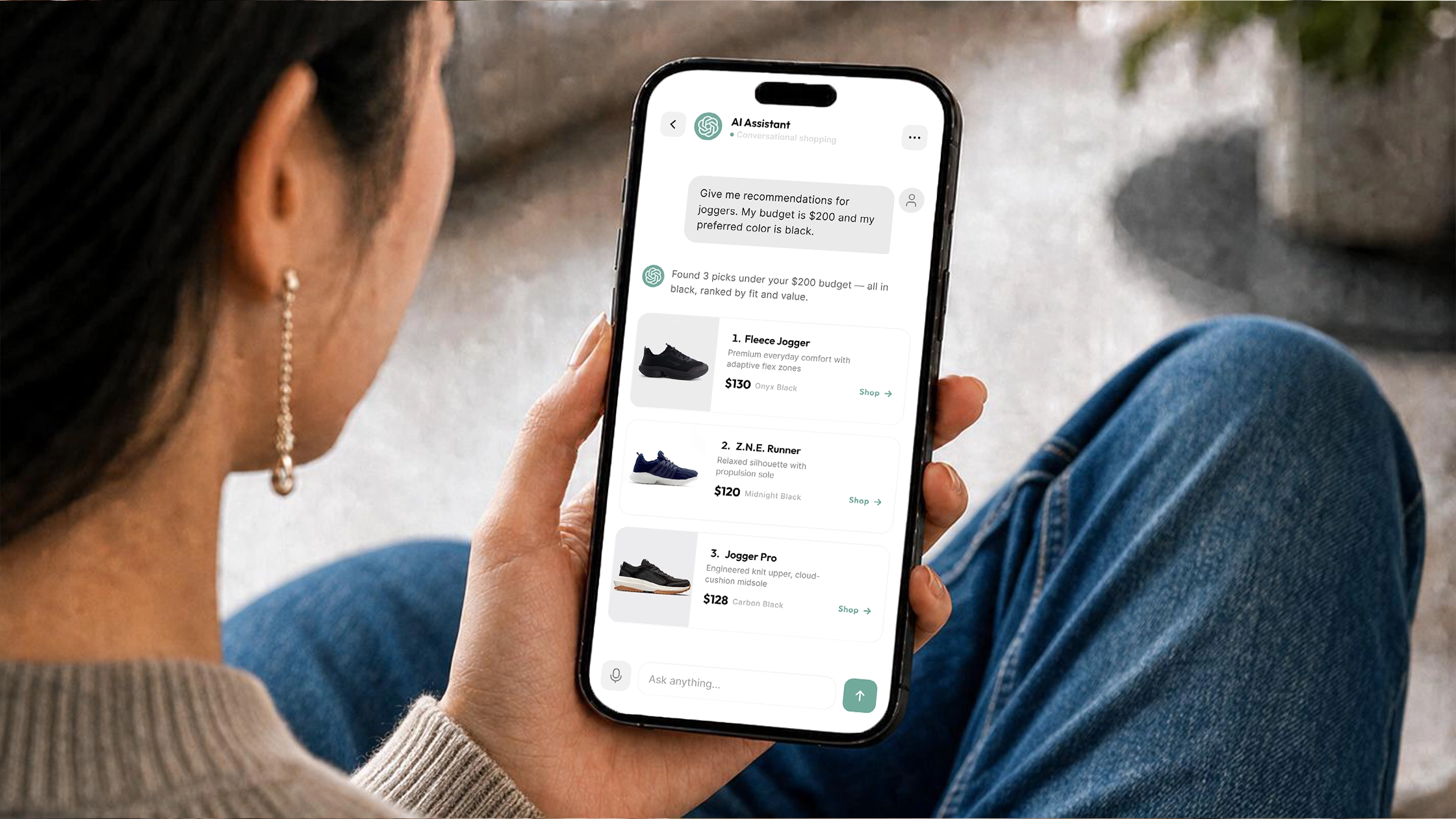
A shopper opens ChatGPT or types a question into Google's AI Overview and asks to recommend running shoes. They include their budget and intended use and get a customized comparison and make a purchase decision before visiting your website. Your SEO ranking may never be seen. Your brand may not even have been mentioned.
This is the uncomfortable reality of AI product discovery that supports customer purchase decisions. For a fast-growing share of shoppers and their AI Shopping Agents, "search" isn't a results page anymore; it's a conversation with an AI system that answers directly and cites a handful of sources.
Being #1 on Google no longer guarantees being discovered. Most retail marketing and IT leaders have no visibility into whether their brand is even in the running for that answer.
AI search in retail is rewriting the discovery playbook
According to Adobe's analysis of AI referral traffic, traffic from AI sources to U.S. retail sites grew 138% year over year in May 2026 and was more than 1,300% higher than October 2024. AI is becoming a meaningful entry point into the retail customer journey. The same research further states that AI-referred retail traffic converted 54% better than non-AI traffic and generated 53% more value per visit. That suggests AI-assisted shoppers can arrive with sharper purchase intent than the average visitor.
Retailers are seeing the shift in their own numbers. According to Target , traffic arriving from ChatGPT to its digital properties was growing by an average of 40% every month, and has reported AI-driven traffic had jumped roughly 2,000% over the last few years.
Put simply: the front door of retail is being rebuilt, and more customers are walking through a door retailers can't see.
Why "ranking #1" doesn't mean what it used to
Ahrefs found that only 12% of URLs cited by ChatGPT, Gemini, and Copilot also ranked in Google’s top 10. Strong Google rankings do not automatically translate into AI visibility. Traditional SEO tactics alone won't earn brand visibility in AI search. A search engine ranks pages for a human. An AI system reads, synthesizes, and answers on the shopper's behalf, so product and brand information must be structured clearly enough to trust, cite, and recommend.
This is generative engine optimization (GEO) and answer engine optimization (AEO). Where SEO earns a ranking, GEO and AEO earn a citation, recommendation, or place inside the answer. For retailers, that shifts the competitive battle from the search results page to the product data beneath it.
As Conversational Commerce becomes a larger part of retail discovery, the ability to be understood and recommended by AI systems becomes increasingly important.
Why most retail catalogs are invisible to AI agents
Most retail product data was never built with an AI reader in mind. Product descriptions were written for humans, not a language model deciding whether a product matches a customer's intent. Attributes are inconsistent across categories. Sizing, material, and compatibility of information often lives in unstructured text or images. Commerce platforms, ERP, PIM, and marketing content can disagree about price, availability, or specifications because there is no single canonical source of truth.
To an AI system deciding whether to cite your product or a competitor's, those inconsistencies create uncertainty. If your catalog is ambiguous, incomplete, or contradictory, the system may recommend the retailer whose data is easier to understand.
This is precisely the challenge Visionet's agentic commerce blueprint for retail was built to address. Making a catalog "agent-legible" isn't a copywriting exercise; it's a data architecture problem. It requires a canonical data model that gives every product one consistent, structured, machine-readable version of the truth, and an integration layer that keeps commerce, content, and operational systems synchronized. Without that foundation, even a well-written product page can struggle to gain brand visibility in AI search.
Visionet's AI Visibility Platform: closing the gap between existing and being found
Closing the gap requires visibility that legacy analytics tools built for a click-through world do not provide.
Visionet's AI Visibility Platform was built for exactly this moment. Rather than measuring only clicks, the AI visibility platform measures whether and how AI systems like ChatGPT, Google Gemini, Google AI Overviews, Claude, and Perplexity represent and recommend a brand. It shows where a brand appears and where it is left out in favor of a competitor. It also shows whether outdated information is shaping how AI talks about the brand and whether commerce systems are ready for AI-driven transactions.
The platform gives retail leaders a clear picture of current AI visibility, a diagnosis of the gaps causing that visibility to fall short, and a prioritized roadmap to close them. That matters as conversational commerce and AI Shopping Agents influence more of the customer journey.
One leading retailer working with Visionet used AI-driven personalization and engagement tools to measurably lift customer engagement and sales growth, as detailed in this case study. Trustworthy, well-structured, AI-ready data also matters when AI systems are trying to understand and surface a retailer's products.
Retailers investing in modern commerce foundations have a head start. The same principles powering AI-driven personalization within Microsoft Dynamics 365 and the structured, high-performance storefronts behind Shopify Plus reinvented with AI help make a catalog legible to AI agents.
From search to answers: Jargon retail leaders need to know
Generative engine optimization (GEO) and answer engine optimization (AEO) help retailers structure their content and product data so AI systems such as ChatGPT, Gemini, and Copilot can accurately understand, cite, and recommend their brands. While GEO focuses on improving visibility within generative AI responses, AEO focuses on making information clear and structured enough to be selected as a direct answer to a shopper's question. Unlike traditional search, which ranks links for shoppers to evaluate, AI search can synthesize an answer directly and surface only a handful of sources. Building brand visibility in AI search therefore requires consistent, machine-readable product information, including attributes, pricing, availability, and specifications, supported by a canonical source of truth across commerce, content, and operational systems. This gives AI Shopping Agents the reliable information they need to confidently understand and recommend a retailer's products.
Being found is only the beginning
Getting cited by an AI system is a meaningful first step. Visibility earns a retailer a place in the conversation. What happens next, whether that mention converts into a visit, add-to-cart, or completed purchase, depends on what the shopper finds once they arrive and whether the retailer's commerce systems can transact directly with the AI agent.
As AI product discovery, conversational commerce, and AI shopping agents become more established, retailers will need to think about discovery and conversion as part of the same connected journey. That's the next question worth asking: once you're discovered, can you convert?
Retail's discovery layer is being rebuilt in real time. Retailers moving early to understand their AI visibility platform capabilities, strengthen their data foundation, and improve brand visibility in AI search will be better positioned to remain part of the recommendation.
Ready to move from insight to action?
Whether you’re exploring new opportunities, solving operational challenges, or planning your next stage of growth, Visionet can help you move forward with clarity and confidence.
Speak with our experts to explore how we can support your business goals.